
In 2026, 68% of U.S. Google searches ended without a single click to any website. In 2024 it was 60%.
Read that again.
The channel most of us built our marketing on is quietly sending fewer visitors, while AI floods every other channel with more content than anyone can read. SparkToro’s clickstream study tracked the first number. Gartner’s 2026 consumer survey tracked the second: 65% of consumers now say brands produce too much AI-generated content.
So is AI helping marketers or hurting them?
Both. And the gap between the two is where the money is.
In this post, I’ll walk you through what the data says about how AI is reshaping marketing: where it’s working, where it’s backfiring, and what you should do about it before the end of this quarter. Every stat below links to the study it came from, so you can check my work.
AI Adoption Is Already Over. Everyone Won.
The debate about whether marketers should use AI is over. Nearly every 2026 survey puts adoption above 90%.
| Report | What it found | Who was surveyed |
|---|---|---|
| Jasper, State of AI in Marketing 2026 | 91% of marketers use AI, up from 63% a year earlier | 1,400 marketers |
| Epsilon, 2026 Benchmark Study | 100% use AI; 91% call it very or extremely valuable | 250+ marketing decision-makers |
| Canva, State of Marketing and AI 2026 | 97% say they use AI daily | Sample size not published on the report page |
So if your plan is “adopt AI and win,” I have bad news. Your competitors did that last year.
Now look at what they’re using it for. In Epsilon’s study, 71% of marketers use AI mainly for productivity and efficiency. Only 9% use it mainly to generate revenue.
That’s the whole story in one stat. Most teams are using AI to do the same work faster. Very few are using it to do better work.
And the cracks are showing. In Jasper’s data, only 41% of marketers say they can prove AI ROI, down from 49% the year before. More tools, less proof.
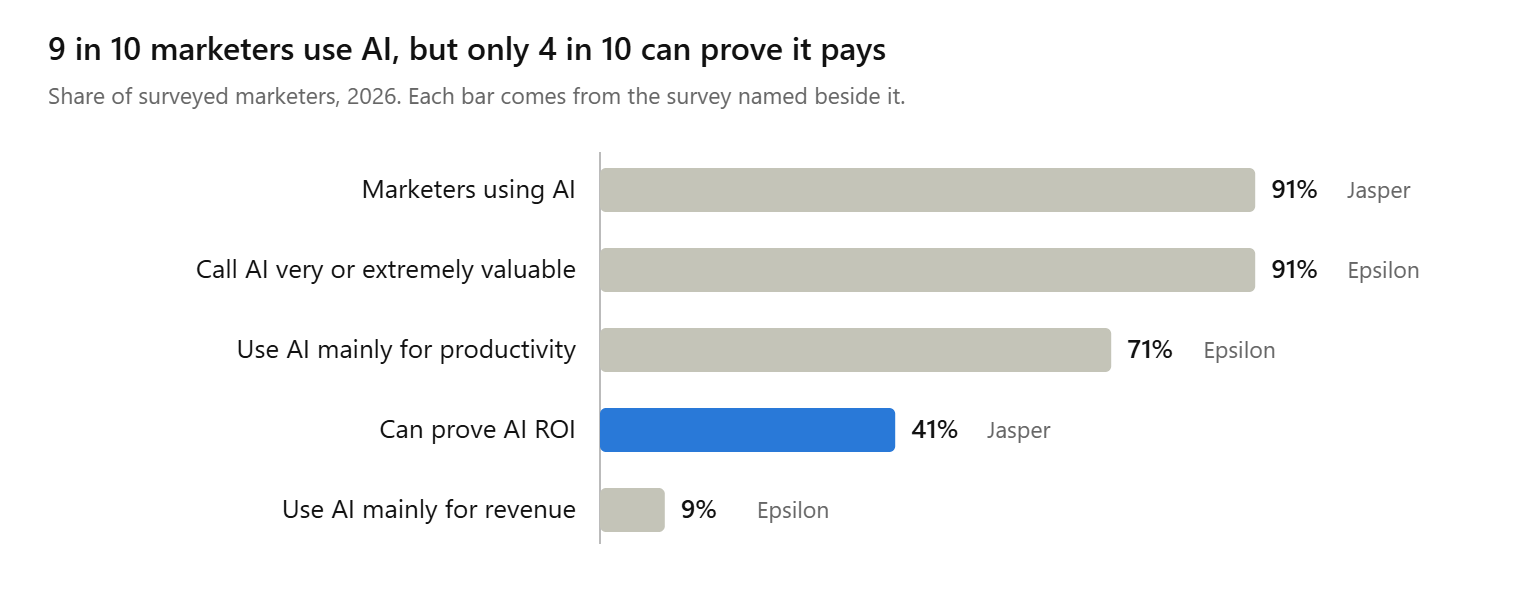
The tool is everywhere. The proof isn’t.
Here’s the part most people skip, though. Among teams that changed how they measure results, 60% report returns of 2-3x or higher (Jasper). The tool isn’t the difference. The measurement is.
One more flag. Epsilon found 67% of C-level marketers rate their organization “extremely mature” at AI, but only 33% of senior managers agree. When the boss thinks you’re crushing it and the people doing the work don’t, that’s a gap you’ll feel in your results.
5 Ways AI Is Reshaping Marketing Right Now
Forget the hype. Here’s where the data says the real shifts are happening.
| The shift | The number behind it | What to do |
|---|---|---|
| Search becomes an answer engine | 68% of U.S. Google searches end with no click | Track impressions and AI citations, not clicks alone |
| Content gets cheap, trust gets expensive | 65% of consumers say brands post too much AI content | Let AI draft, add a human point of view |
| Personalization becomes the default | 71% expect it (McKinsey, 2021) | Personalize one segment well |
| Speed and cost drop | 50% ship faster, 45% cut costs | Put saved time into original research |
| Measurement becomes the bottleneck | 41% can prove AI ROI | Audit analytics before buying tools |
1. Search Is Turning Into an Answer Engine
This is the biggest change, and most marketers are still treating it like a rankings problem.
SparkToro’s study of U.S. Google searches (January to April 2026, using Similarweb data) found that 68.01% ended with no click. AI Overviews showed up on more than 20% of searches, and when they appeared, click-through rates dropped by nearly 60%.
A separate randomized field study (1,065 U.S. participants, run by researchers at the Indian School of Business and Carnegie Mellon) found AI Overviews cut organic clicks by 38% on queries where they appeared. It’s a working paper and hasn’t been peer reviewed yet, so treat the exact number as a direction, not a law.
The direction is clear, though. Ranking #1 is worth less than it was. Being the source the answer is built from is worth more.
What to do: Stop measuring SEO by clicks alone. Track impressions, branded search, and whether your pages get cited in AI answers.
2. Content Is Now Cheap. Trust Isn’t.
Content creation is the most common AI use case in marketing. Which means everyone can now publish ten articles a day.
And consumers have noticed. In Gartner’s survey of 1,006 U.S. consumers (fielded May to June 2026), 65% said brands produce too much AI-generated content, and 57% said it has made them trust brand messaging less. On top of that, 43% now rely more on real people for shopping advice because of AI content.
Here’s the twist. Bynder tested 2,000 U.S. and U.K. consumers with two unlabeled articles, one by ChatGPT and one by a professional copywriter. 56% of those with a preference found the AI article more engaging. When people were told it was AI, 52% said they felt less engaged.
Read that carefully. The writing isn’t the problem. The feeling of being handled by a machine is.
What to do: Use AI for the first draft and the research. Put a human voice, a real opinion, and original data on top.
3. Personalization Is Becoming the Default Expectation
This one isn’t new, but AI is what makes it affordable. McKinsey’s research found 71% of consumers expect personalized interactions, and 76% get frustrated when they don’t get them. Faster-growing companies drove 40% more of their revenue from personalization than slower-growing peers.
That research is from 2021, before generative AI hit the mainstream. The expectation has only gone one way since.
What to do: Start with one segment and one message you can actually personalize well. Don’t try to do 50 at once.
4. Speed and Cost Are Dropping Fast
In Jasper’s survey of 1,400 marketers, 50% said they’re bringing work to market faster, and 45% said they’ve lowered operating costs. On top of that, 75% of AI users reported higher job satisfaction.
Small teams can now ship what used to take a whole department. That’s good news if you’re lean. It’s bad news if your edge was being faster than the competition, because now everyone is. For agencies, white-label design is one way to add capacity without adding headcount.
What to do: Reinvest the time you save into the things AI can’t do: customer interviews, original research, and sharper creative.
5. Measurement Is the New Bottleneck
We covered this above, but it deserves its own spot. Only 41% of marketers can prove AI ROI, down from 49% (Jasper). And 45% name data quality as their top AI challenge (Epsilon).
AI is only as good as the data you feed it. Messy tracking in, messy decisions out.
What to do: Before you buy another AI tool, audit your analytics setup. If you can’t trust your conversion data, no model can fix that for you.
What AI Still Can’t Do (And Why That’s Your Opportunity)
Here’s the thing about a technology everyone has access to: it stops being an advantage.
What’s left is everything it can’t copy. And the data suggests audiences know exactly what that is.
Canva’s 2026 report found 87% say the best advertising still needs a human touch. The page doesn’t say who was surveyed or how many, so I’d treat it as a signal rather than a hard benchmark. But it lines up with everything else we’ve seen. That human layer is what separates forgettable ads from good marketing and advertising design.
Gartner found 35% of consumers rely on influencers less because of AI, while 43% lean harder on real people. In other words, trust is migrating toward humans who can prove they’re human.
And the Bynder survey shows the nuance. 82% of consumers don’t mind brands using AI to help write copy, as long as it feels human-written. Among people 55 and older, 71% want AI use disclosed, compared with 45% of 16 to 24 year olds.
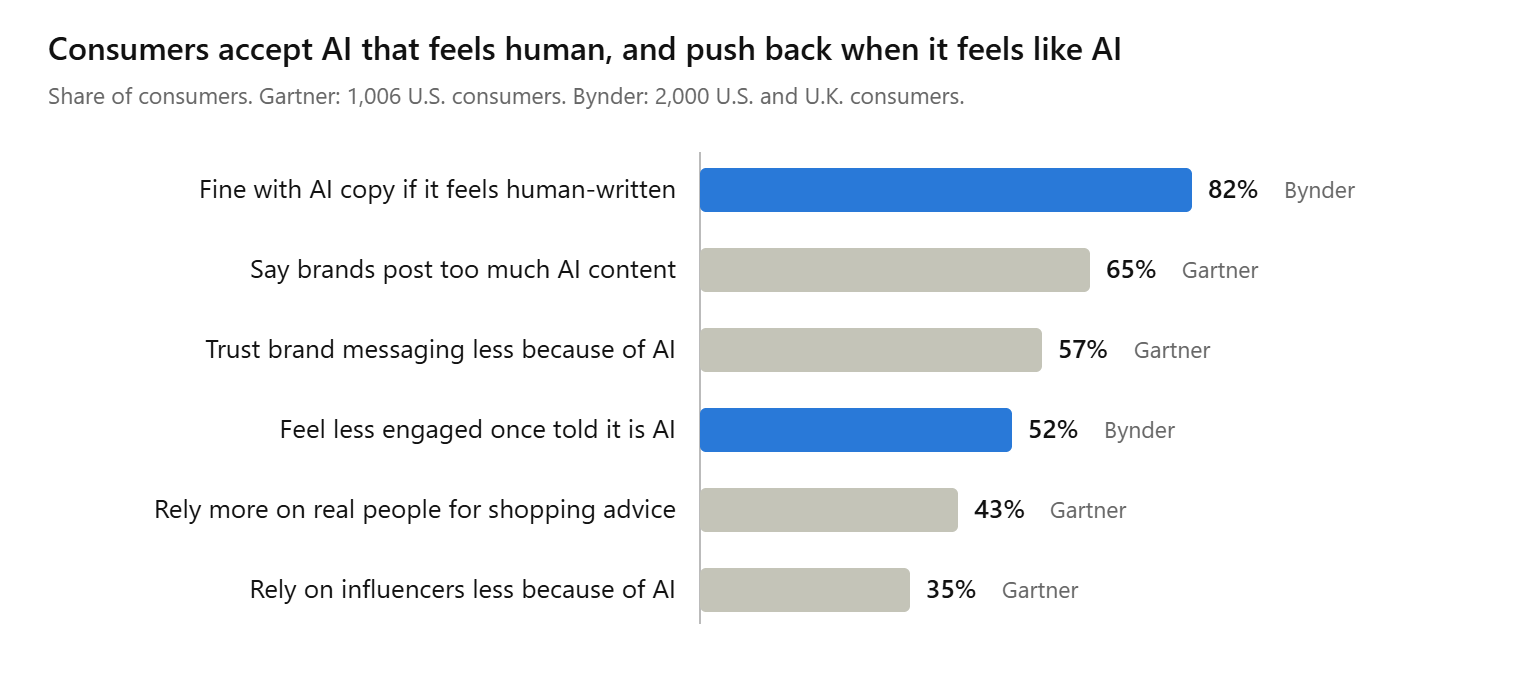
Same words, different verdict. The label changes how people read it.
So the rule isn’t “don’t use AI.” It’s this: don’t let it show.
Three things AI can’t fake yet:
- Original data. A model can summarize what’s already published. It can’t run your survey or pull your customer numbers.
- A real point of view. AI averages the internet. Opinions that cost you something to publish are rare.
- Lived experience. Case studies, mistakes, specifics. The details only someone who did the work would know.
Here’s how I’d split the work on any marketing project:
| Task | Let AI handle | Keep it human |
|---|---|---|
| Research | Summarizing sources, pulling themes | Choosing what’s credible, checking every stat |
| Writing | Outlines and first drafts | Voice, opinions, real examples |
| Data | Cleaning and sorting | Collecting original data, deciding what it means |
| Creative | Variations and resizing | The concept and the taste |
| Measurement | Reports and anomaly flags | Deciding what counts as success |
We’ve covered how AI is changing graphic design in more detail here.
Your 30-Day Playbook
You don’t need a bigger AI budget. You need a sharper plan. Here’s what I’d do this month.
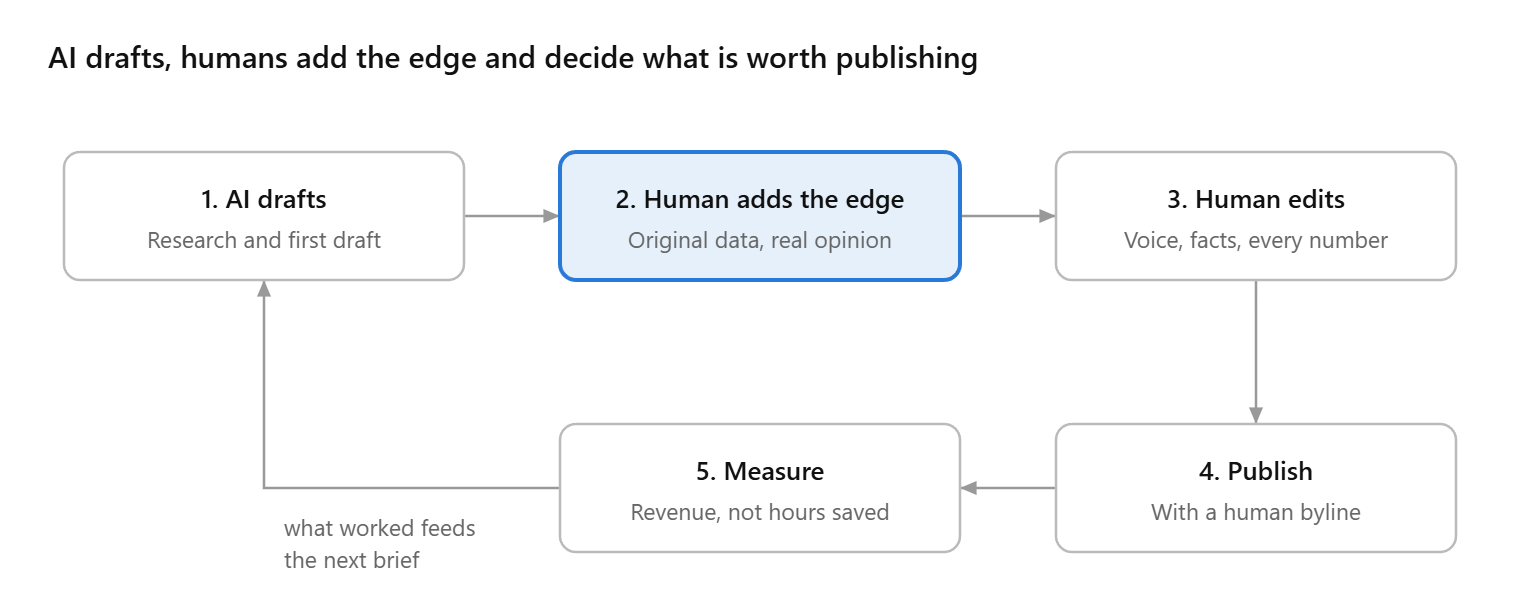
The workflow behind the steps below: AI does the first pass, people add what a model can’t, and the results decide the next brief.
- Audit where your clicks went. Pull 12 months of Search Console data. Find the pages where impressions held but clicks fell. Those are your AI Overview casualties.
- Rewrite for citation, not just ranking. Lead with the direct answer, then back it with a number and a source. Answer-first pages are easier for readers and AI answers to use.
- Add one human-only asset per month. An original survey, a customer teardown, an expert quote. Something no model can generate from public data.
- Set a rule for AI-assisted content. Drafts and research: yes. Publishing without a human edit: no. Write it down so the whole team follows it.
- Fix your measurement before you scale. Clean up conversion tracking, then tie AI projects to revenue, not hours saved. Remember, only 9% of teams in Epsilon’s study use AI mainly for revenue.
- Personalize one thing well. One audience, one email sequence or landing page. Measure the lift, then expand.
- Re-check the numbers in 90 days. This space moves fast. One study above is an unreviewed working paper and a few don’t publish full methodology, so update your assumptions as better data lands.
The Bottom Line
AI isn’t going to replace marketers. It’s going to replace average marketing.
The teams that win from here will do two things at once: use AI to move faster, and invest more in the human work that makes people trust them. Speed without trust is spam. Trust without speed is a hobby.
Start with one move this week. Open your analytics, find the pages that lost clicks, and fix the first one.
Need design help that doesn’t look like everyone else’s AI output? That’s what our unlimited graphic design subscription is built for. Start a 7-day free trial and let’s build something your audience can tell a human made.