
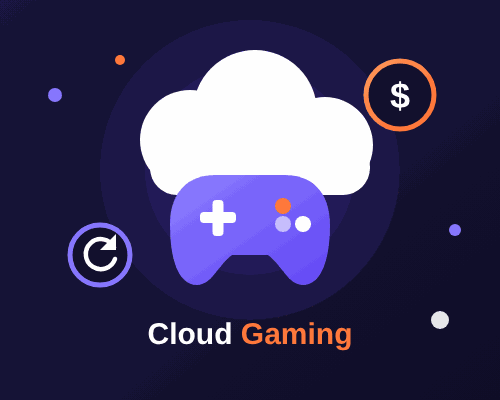
“Cloud gaming” is trending in the US right now. Most founders will scroll right past it.
That’s a mistake.
Cloud gaming is a subscription business. It sells access instead of ownership, bills monthly, fights churn, runs good-better-best tiers and gets punished fast when it gets pricing wrong. Sound familiar? It’s SaaS with a controller.
In this post you’ll get 7 lessons from the cloud gaming playbook, a data table you can screenshot, and a short checklist to run on your own pricing page this week.
Why cloud gaming is trending (and why you should care)
The spark this week is a debate about hardware prices. Former PlayStation boss Shawn Layden has argued that a PS6 priced near $1,000 can’t justify itself on raw power alone. In a July 2026 interview covered by TechRadar, he said the industry needs to “bring out more games for more people.” Cheaper, simpler and broader beats more expensive and more powerful.
Cloud gaming is the obvious answer to that tension. You stream the game, so you don’t need the expensive box. And the market is growing fast. One industry roundup from Levvvel puts the cloud gaming market at about $2.27 billion in 2024 and about $3.36 billion in 2025, projecting roughly $21 billion by 2030 (around 44% a year). Heads up: the page doesn’t name the original research firm, so treat those figures as directional, not gospel.
Quick take: Gaming platforms learn about subscription pricing in public, with millions of angry customers watching. You get to learn from their mistakes for free.
Lesson 1: A price change is a brand event, not a spreadsheet edit
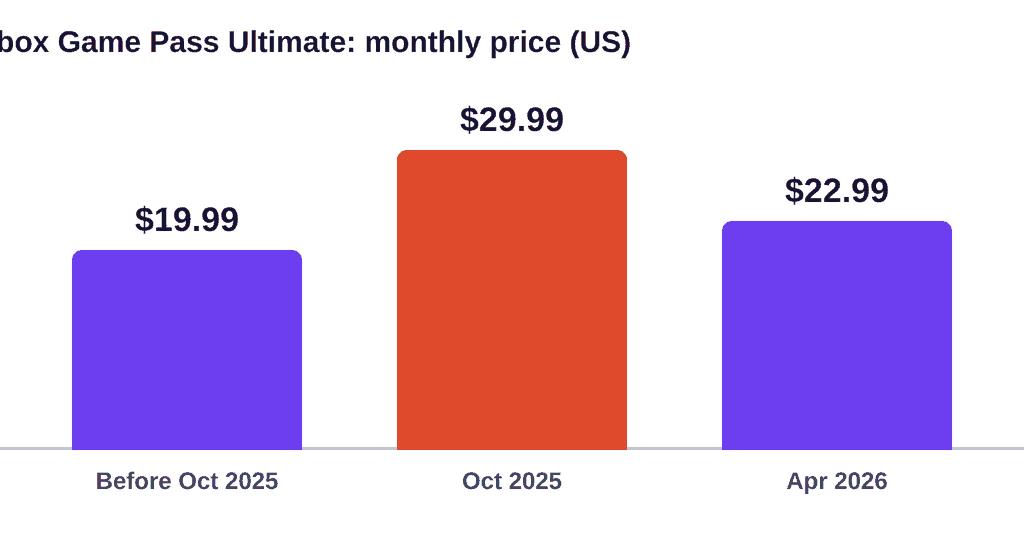
Here’s the cleanest case study in subscription pricing from the last year. Xbox Game Pass Ultimate went from $19.99 to $29.99 a month in October 2025. That’s a 50% jump. Then on April 21, 2026 it was cut to $22.99, according to the Game Pass statistics roundup from ShanetheGamer. That page also reports a Microsoft memo saying the hike caused “millions of subscribers” to leave, and cites a Wall Street Journal report of roughly 30 million subscribers in July 2026, down about 4 million from the last official figure of 34 million in February 2024. Those are reported figures, not official ones.
What to do
- Test price increases on new customers first. Grandfather existing ones for at least one cycle.
- Announce changes with the reason, the new value and the date. Silence reads as greed.
- Redesign the pricing page and the in-app upgrade screens before you flip the switch, not after the angry emails arrive.
Need more on how pricing pages actually convert? Our guide to SaaS pricing page design lessons from Disney+ covers the layout side.
Lesson 2: Name tiers by who they’re for
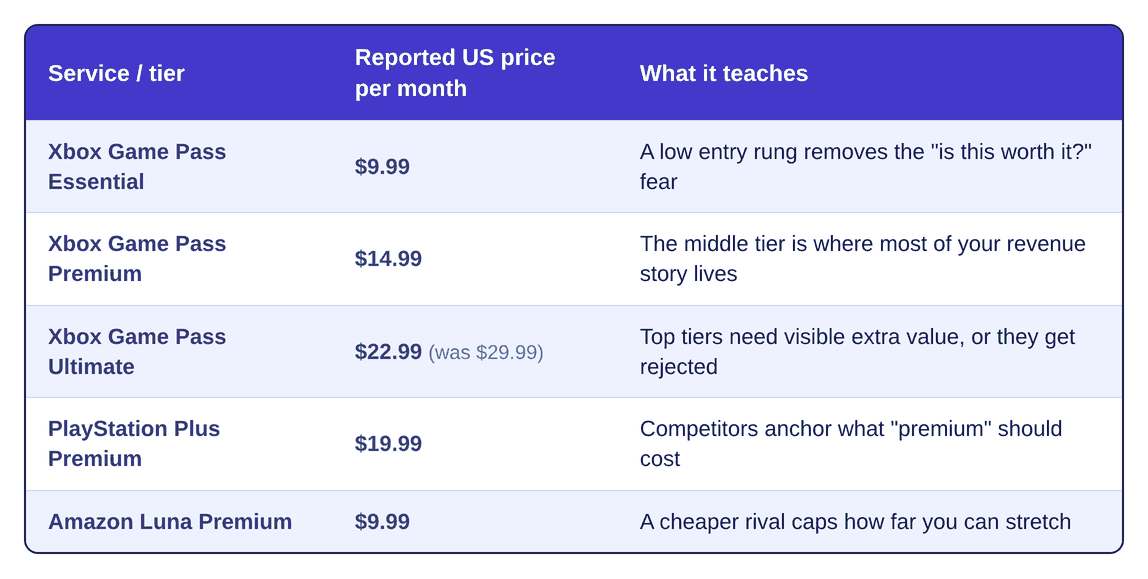
Game Pass runs a three-rung ladder: Essential at $9.99, Premium at $14.99 and Ultimate at $22.99 (US prices as of April 2026, per the same ShanetheGamer roundup). Other services follow a similar ladder. PlayStation Plus Premium is listed at $19.99 and Amazon Luna Premium at $9.99, per Levvvel. Prices change often, so check live pages before you quote them anywhere.
What to do
- Use three plans. Name them for the buyer (“Solo”, “Team”, “Company”), not for the features.
- Mark one plan as the obvious pick with a badge and stronger color.
- Write one outcome sentence per plan above the price.
Lesson 3: Never hide the limit
Cloud gaming has a built-in cost problem: every hour a customer plays costs the provider real compute. So services use caps. Per Levvvel, NVIDIA’s GeForce NOW introduced a 100-hour monthly cap on January 1, 2026.
Your SaaS has the same issue with seats, API calls, storage, AI credits and exports. The lesson isn’t “don’t cap.” It’s “don’t surprise people.”
What to do
- Put the limit on the pricing card in plain words, not in a footnote.
- Show a usage meter inside the product that turns amber at 80%.
- Send the “you’re near your limit” email with a one-click upgrade, not a warning.
Lesson 4: Protect the core promise before you touch the price
The same Game Pass story has a quieter detail. According to the ShanetheGamer roundup, future Call of Duty titles no longer launch day one on Ultimate or PC Game Pass. When a subscription removes the thing people signed up for, the price feels higher even if the number doesn’t move.
Your equivalent might be a feature you move from Pro to Enterprise, an integration you deprecate or a free tier you shrink. All of those are price increases in disguise.
What to do
- List the 3 reasons your best customers pay you. Don’t touch those without notice.
- If you must retire something, follow a plan. Our product sunsetting playbook walks through it step by step.
Lesson 5: “No hardware needed” is an onboarding strategy
The pitch of cloud gaming is zero friction: click, play, done. Levvvel’s roundup says 60% of cloud gamers cite playing without expensive hardware as a key benefit, and that about 45% mainly stream on mobile. (No original source is named for those usage figures, so use them as a gut check, not a citation in a pitch deck.)
Now look at your signup flow. How many steps, forms and emails sit between a stranger and their first win?
What to do
- Offer a “try it now” demo with sample data and no signup wall.
- Cut your signup form to the fields you truly need on day one.
- Design the first screen around one action, not a tour of every feature.
- Check the mobile version. If 45% of your users could be on a phone, your onboarding must work there.
Not sure where your funnel leaks? Start with our landing page audit: 12 fixes to make before you spend on ads.
Lesson 6: Know your churn number by segment
Gaming subscriptions lose people every time a big title ends or a price rises. SaaS loses people for similar reasons, but the numbers differ a lot by customer size. Stripo’s 2026 benchmark report compiled the following.
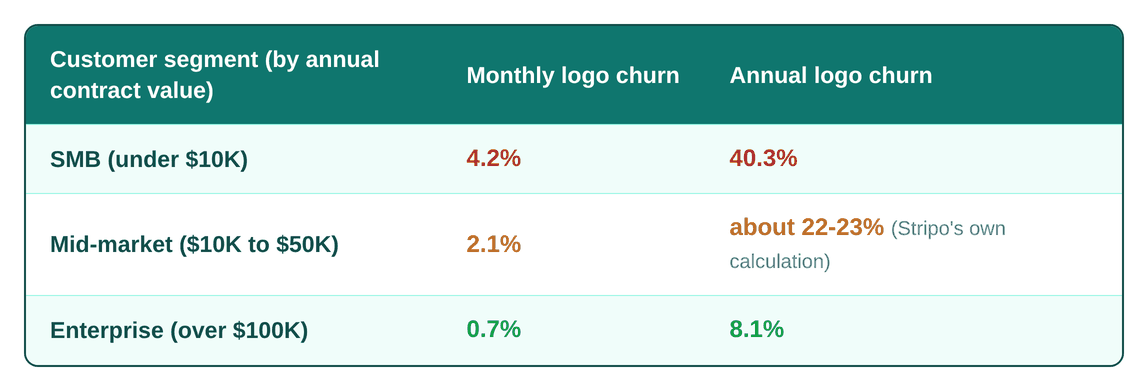
The same report links each extra $25,000 of contract value to roughly 0.8 points less monthly churn, and notes that 85% of deals above $50K are on annual or multi-year terms. Bigger, committed customers stay. Small, month-to-month customers leave.
What to do
- Track churn separately for each plan, not as one blended number.
- Nudge monthly buyers to annual with “2 months free” style offers, and keep the monthly option visible.
- Build a clear cancel flow that offers a pause or a downgrade before it offers a goodbye.
Lesson 7: Build the cheaper door (and make it good)
Layden’s core argument is simple: charging more for more power isn’t a strategy when customers want more reach. The cloud gaming answer is a cheaper, lighter entry point that still feels like the real product.
For SaaS, that means a low-priced plan, a usage-based start or a free tier that actually delivers a win. Don’t make it a crippled demo. Make it a small, honest version of the full thing.
What to do
- Define the smallest plan that solves one real problem end to end.
- Show an upgrade path in the product, with the next tier visible but never pushy.
- Brand the entry plan well. Cheap doesn’t have to look cheap.
Your 10-minute pricing page checklist
- Count your plans. If you have more than three, merge or hide one.
- Pick your recommended plan and make it visually obvious.
- Write the limit of each plan in plain language.
- Add “cancel anytime” and a monthly/annual toggle that defaults to annual.
- Open the page on a phone and tap every button with your thumb.
- Check what you changed in the last 90 days. Did any change remove value?
Common mistakes to avoid
- Copying a giant’s pricing. Microsoft can absorb a pricing misstep. A seed-stage startup can’t.
- Changing price and packaging at the same time. You won’t know which one caused the churn.
- Treating design as decoration. A confusing pricing page loses deals even when the price is right.
Where design does the heavy lifting
Look back at the seven lessons. Almost every one is a design decision in disguise: hierarchy on the pricing card, clear limits in the UI, a short signup flow, a good upgrade screen, a cancel flow that doesn’t feel hostile. Pricing strategy only works when the interface makes it easy to understand.
That’s also why pricing and onboarding are never “done.” You’ll test new plan names, new badges, new mobile layouts and new upgrade prompts every quarter. That’s a lot of small design tasks.
Ready to fix your pricing and onboarding design?
Draftss gives startup teams an unlimited design subscription: pricing pages, landing pages, product UI, onboarding screens and brand assets, delivered fast and iterated as your tests come in. No hiring, no agency retainers, no waiting weeks for a revision.
Curious how design subscriptions compare? Read our roundup of the top unlimited graphic design services in 2026, or see how creator partnerships can work for B2B SaaS.
Start your Draftss subscription today and turn your pricing page into your best salesperson.