
Everyone’s using AI to create content. Almost nobody is asking whether their audience wants them to.
That’s a problem. Because the data says people are noticing, and many don’t like it. Clearly showing an affinity towards human-designed content.
In this post, I’ll show you exactly where audiences accept AI, where they push back, and the framework I’d use to get the speed of AI without paying for it in lost trust.
The AI trust gap, in numbers
Let’s start with what consumers actually say.
The Meltwater and YouGov study Trust in the Age of Generative AI (April 2026, nearly 10,000 consumers in seven markets) found:
- 86% say AI-generated content should be disclosed.
- 32% would trust brands less if their content is AI-generated, versus 15% who would trust them more.
- 58% believe they can identify AI-generated content.
- 73% are concerned about misinformation.
Then there’s the Clutch survey of 601 consumers, fielded in August 2026:
- 86% have already encountered AI-generated content on social media.
- 53% are less likely to buy from brands they know use AI in social content.
- 71% would question a human influencer’s recommendation if AI created their content.
- Nearly 90% say brands and creators should disclose AI content.
One more useful data point: Kapwing’s roundup of AI video statistics cites research suggesting that well-made, disclosed synthetic ads can perform comparably to original ads on purchase intention. In other words, how you use AI matters more than whether you use it. (Note: Kapwing aggregates figures from several third-party sources, so treat the individual numbers as directional.)
Where audiences accept AI (and where they don’t)
Meltwater’s data shows acceptance varies a lot by content type:
| Content type | Audience acceptance of AI |
|---|---|
| Entertainment | 53% |
| Advertising | 47% |
| Influencer content | 28% |
| News | 21% |
Source: Meltwater and YouGov, April 2026.
The pattern is clear. The more personal and trust-dependent the content, the less people tolerate AI. Founder posts, testimonials and “real customer” stories live at the low-acceptance end of that spectrum.
AI vs. human design: an honest comparison
Let’s be fair. AI is a powerful tool. Here’s how I’d compare the two for startup design work:
| Factor | AI-generated | Human-designed |
|---|---|---|
| Speed | Seconds to minutes | Hours to days |
| Cost per asset | Very low | Higher per asset, lower with a subscription |
| Brand consistency | Inconsistent without heavy guidance | Strong with a brief and brand kit |
| Originality | Often generic or derivative | Distinctive when briefed well |
| Strategic thinking | None on its own | Understands goals, audience, context |
| Ownership clarity | Can be murky | Clear work-for-hire terms |
| Audience trust risk | Higher when undisclosed | Lower |
| Best for | Ideation, variations, internal drafts | Brand identity, hero assets, public-facing work |
The winner isn’t one or the other. It’s knowing which tool fits which job.
The “Trust Ladder”: a simple framework for using AI
Here’s a framework I recommend. Sort every piece of content into one of three rungs.
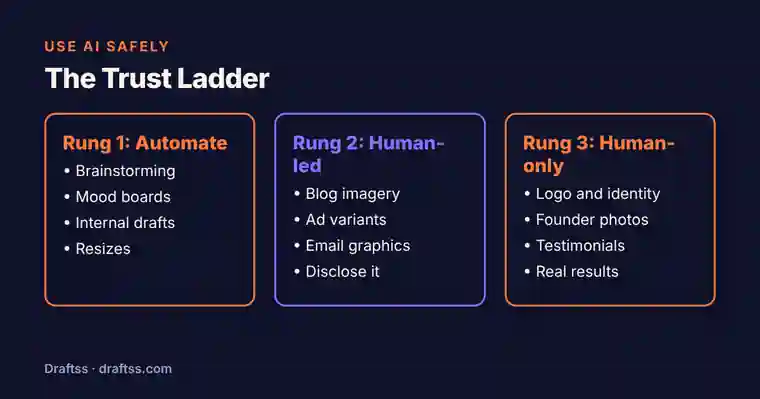
Rung 1: Safe to automate (low trust risk)
- Brainstorming headlines and concepts
- Mood boards and reference gathering
- Internal decks and first drafts
- Resizing and format variations of approved designs
- Alt text, transcripts and basic summaries
Use AI freely here. Nobody outside your team sees it, or it’s a mechanical task.
Rung 2: AI-assisted, human-led (medium trust risk)
- Blog and social imagery
- Ad concepts and A/B variants
- Email graphics and presentation visuals
- Product explainer drafts
Let AI speed up the early stages, but have a designer refine, brand and approve the final version. And disclose where it fits. With 86% of consumers wanting disclosure, a simple line like “Illustrations created with AI assistance and refined by our design team” is cheap insurance.
Rung 3: Human-only (high trust risk)
- Logo and core brand identity
- Founder and team photography
- Customer testimonials and case studies
- Anything representing real people, real results or real products
Never fake this layer. When 64% of surveyed consumers say they’d trust a brand less if AI misrepresented its products, the downside dwarfs the savings. For a deeper look at the risk, read what the Pokimane deepfake backlash teaches startups about brand trust and our guide to protecting your visual identity from deepfakes.
7 rules for using AI without losing trust
- Disclose by default. Make it a policy, not a case-by-case decision.
- Never use AI for testimonials or “customers”. Real people only.
- Keep a human in the loop. Every public asset gets a designer’s eye.
- Protect your brand kit. Feed AI your colors, fonts and style rules, then check the output against your cohesive branding guidelines.
- Audit for “AI tells”. Odd hands, garbled text, plastic skin, generic stock-style compositions. If you can spot it, your audience can too.
- Check licensing and ownership. Understand the terms of every tool you use before putting its output in a commercial product.
- Test with your audience. Run A/B tests of AI-assisted versus human-made creatives and let the data decide for your market.
Real-world example: the hybrid workflow
Here’s what a lean startup team could do for a product launch:
- Strategy (human): Define audience, message and brand direction.
- Ideation (AI): Generate 30 headline and concept ideas in 20 minutes.
- Selection (human): Pick the best 3 and brief a designer.
- Design (human, AI-assisted): Designer builds final assets, using AI only for background elements or variations.
- Review (human): Check for brand fit, accuracy and AI artifacts.
- Publish with disclosure: Add a short note where AI played a meaningful role.
You get most of the speed, and your audience gets work that feels intentional.
The mistake to avoid
The biggest mistake isn’t using AI. It’s using it quietly, and getting caught.
People forgive tools. They don’t forgive feeling tricked. Meltwater’s research shows 58% of consumers believe they can spot AI content, and that confidence alone makes them quick to call it out.
Final thoughts
AI won’t replace good design. It will replace slow, generic, unbranded design. The brands that win will pair AI’s speed with human taste, strategy and honesty.
So use AI where it helps. Disclose where it matters. And keep humans in charge of anything your audience needs to believe.
Want human-crafted design at the speed of AI? Draftss gives startups a dedicated design team on a flat monthly subscription. Unlimited requests, fast turnarounds and brand-consistent results. Try Draftss and get your first design back fast.