
Pokimane is trending in the US today. And if you run a SaaS company, your first reaction is probably: “Cool, but what does a streamer have to do with my product?”
More than you think. Streamers and creators have spent years mastering the one thing most startups still struggle with: getting a real audience to trust them. Creator partnerships for SaaS are how smart B2B teams borrow that trust instead of waiting years to build it from scratch.
In this guide you’ll get the numbers, a tier-by-tier comparison, a 5-step playbook, and the design assets you need so a creator deal actually turns into signups.
Why B2B Brands Are Finally Taking Creators Seriously
Creator marketing used to mean sneakers and skincare. Not anymore.
- 85% of B2B marketers now include influencer marketing in their strategy, up from 34% in 2020, according to TopRank Marketing’s 2025 research, summarized by ContentGrip.
- The global influencer marketing industry reached an estimated $32.55 billion in 2025, and 87.49% of marketers expect their budgets to grow, per Influencer Marketing Hub’s 2026 statistics roundup.
- When B2B brands are asked about goals, 67% cite brand awareness and 54% cite credibility and trust (Sprout Social Q1 2025 Pulse Survey, via ContentGrip).
Read that last line again. Credibility is the product you are selling before anyone ever opens your pricing page. Creators already have it. You are renting a slice of it.
What the Data Says About Results (and the Catch)
The headline figure you will see everywhere is roughly $5.78 returned per $1 spent on influencer marketing. Influencer Marketing Hub reports it, though it does not name the underlying study, so treat it as a directional benchmark, not a promise.
Here is the more useful pattern. Programs that stay on all year beat one-off stunts:
- 99% of B2B marketers running always-on programs rate them effective.
- Marketers without always-on programs are 17 times more likely to call their programs ineffective (TopRank Marketing 2025, via ContentGrip).
And the catch? Measurement is messy. 79% of enterprise marketers struggle to measure influencer ROI, and 48% name attribution as their biggest gap (Linqia, via Influencer Marketing Hub). Fraud is real too: 81% of senior marketers encountered influencer fraud in the past 12 months, with a median of $128,000 wasted per affected mid-scale program (World Federation of Advertisers, via ContentGrip).
Translation: creators work, but only if you pick well and track properly.
Step 1: Pick the Right Creator Tier (Bigger Is Not Better)
Founders love a big name. Resist it. Engagement data from Influencer Marketing Hub shows why:
Median engagement rate by creator size (source: Influencer Marketing Hub, 2026)
1K–10K followers
Over 1 million followers
On Instagram Reels, a creator with over a million followers gets roughly half the engagement rate of a creator with 1K to 10K followers. Small audiences are not weak audiences. They are tight ones.
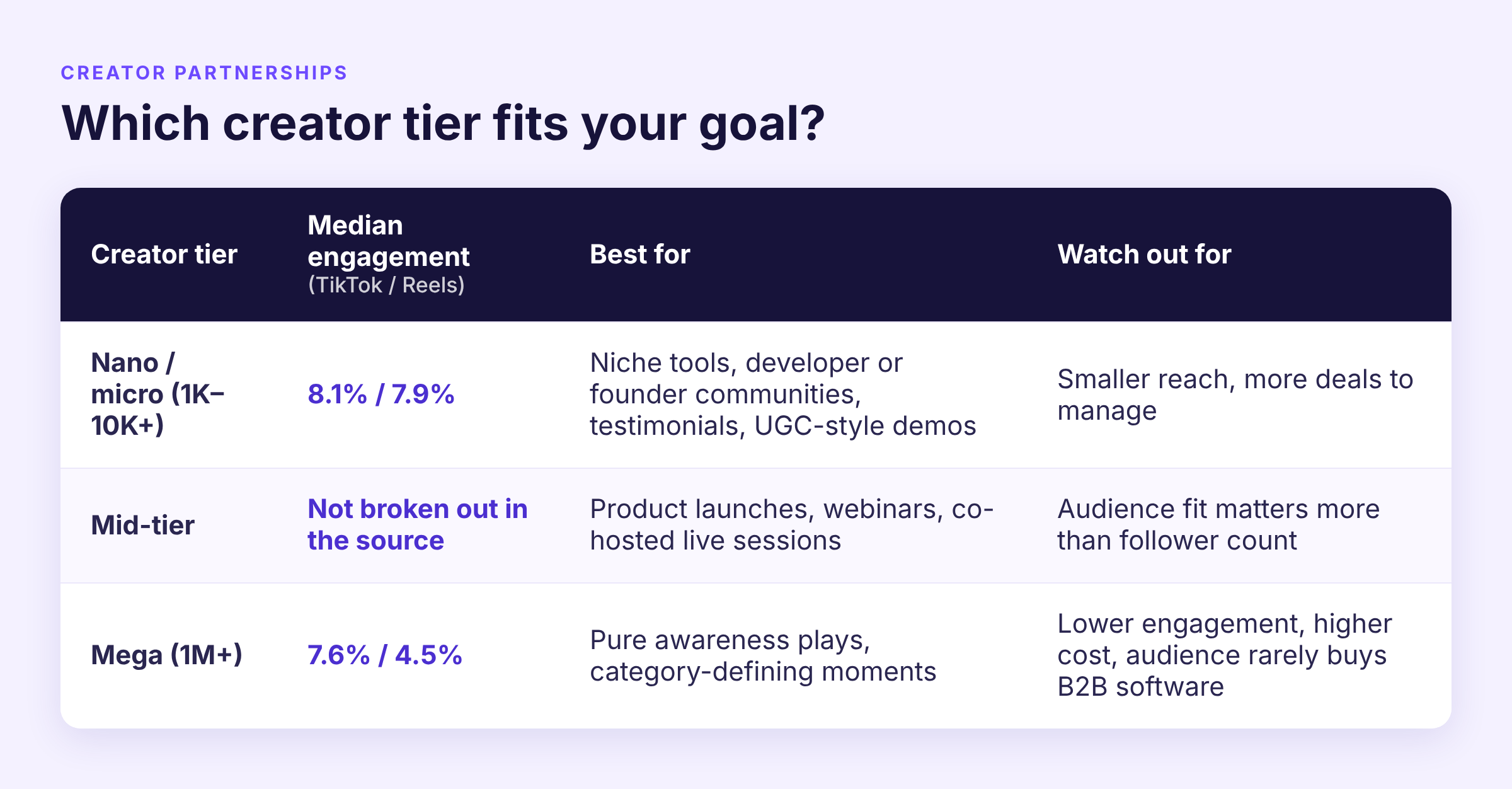
Cost is where small creators shine. About 55% of nano-creator UGC price ranges and 45.5% of micro-creator ranges fall below $500 (Influencer Marketing Hub). For a seed-stage startup, that is ten small bets instead of one big one.
The “audience-fit” filter
Before you shortlist anyone, answer three questions:
- Do their viewers hold the job title or problem your product solves?
- Do they already talk about software, work, or building things?
- Would you be proud to see your logo next to their face?
If it is a no on any of them, move on. A streamer with a huge gaming audience is a poor fit for an invoicing tool. A streamer who co-hosts a startup show is a great one.
Step 2: Choose the Platform Where Your Buyers Actually Pay Attention
Instagram is used by 85% of brands for creator marketing, and 29% say it delivers their best creator ROI versus 27% for TikTok. TikTok leads 2026 investment intentions at 31% (Influencer Marketing Hub). For B2B specifically, do not ignore LinkedIn and YouTube, where buyers go to research tools.
Rule of thumb: discovery lives on TikTok and Reels, consideration lives on YouTube and LinkedIn. Plan content for both.
Step 3: Price the Deal Like a Performance Test, Not a Sponsorship
Here is where most SaaS teams burn cash. They pay a flat fee, get a mention, and then wonder why nothing happened.
Try a hybrid structure instead:
- A small base fee for the content itself.
- A performance kicker tied to trials, signups, or demos booked.
- A usage license so you can repurpose the content in paid ads. Aspire reports that 77% of brands already repurpose creator content in paid campaigns.
For tracking, keep it simple. Promo codes are the most-used tool at 45.9%, followed by affiliate links at 26% (Influencer Marketing Hub). Give every creator a unique link and code on day one.
Step 4: Protect Trust (Disclosure and Authenticity)
This is the part founders skip, and it is the part that can sink you.
- 70% of consumers feel deceived when a brand relationship is not disclosed.
- Only 5% completely trust influencer content, although 74% trust it at least somewhat (Influencer Marketing Hub).
So: require clear paid-partnership labels, and let creators speak in their own voice. Scripts that sound like press releases tank performance and trust at the same time. We also cover how to borrow a cultural moment without losing your identity in our guide to brand licensing for startups.
Step 5: Design the Assets That Make the Partnership Convert
A creator can send you traffic. Your design decides whether it turns into signups. Before the first post goes live, get these ready:
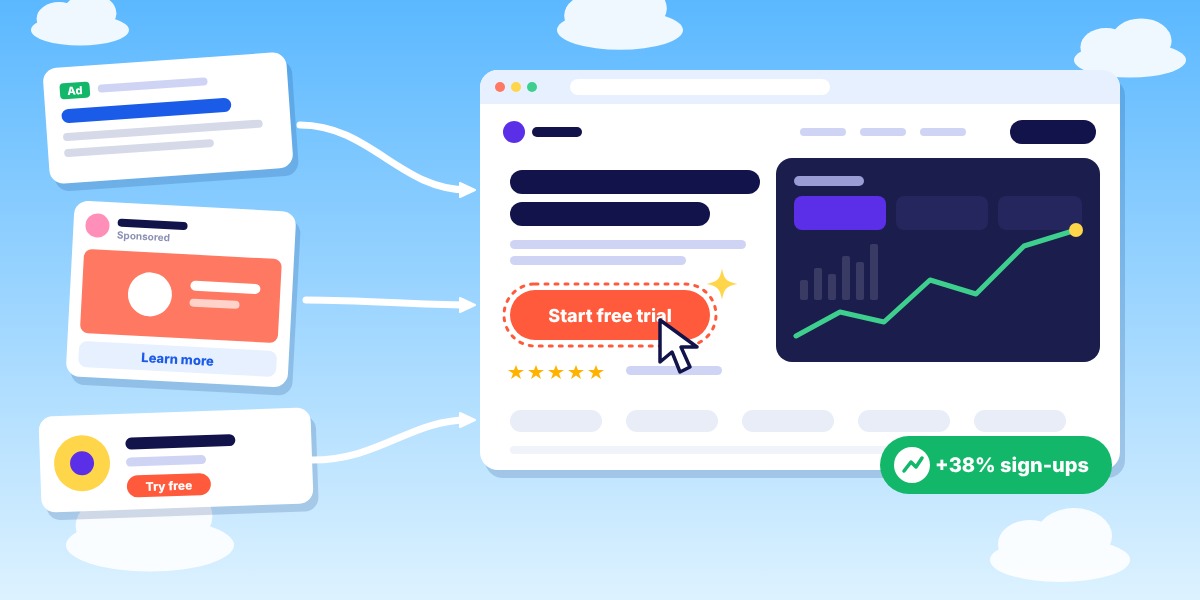
- A dedicated landing page for each creator or campaign, with the creator’s name, a matching headline, and the offer above the fold.
- A co-branded asset kit: logo lockups, color-safe overlays, thumbnails and banner sizes for each platform.
- Social templates creators can drop their footage into. See our guide to creating stunning social media graphics for the basics.
- Ad variants built from creator content, sized for every placement.
- A consistent brand system so the partnership still looks like you. Start with a solid logo and brand identity.
Time-boxed creator drops also pair well with deadline-driven offers. Done honestly, that is the approach we describe in limited-edition marketing for SaaS.
A Quick Example Campaign (Illustrative)
Say you sell a project-management tool for small agencies. Here is a lean 30-day test:
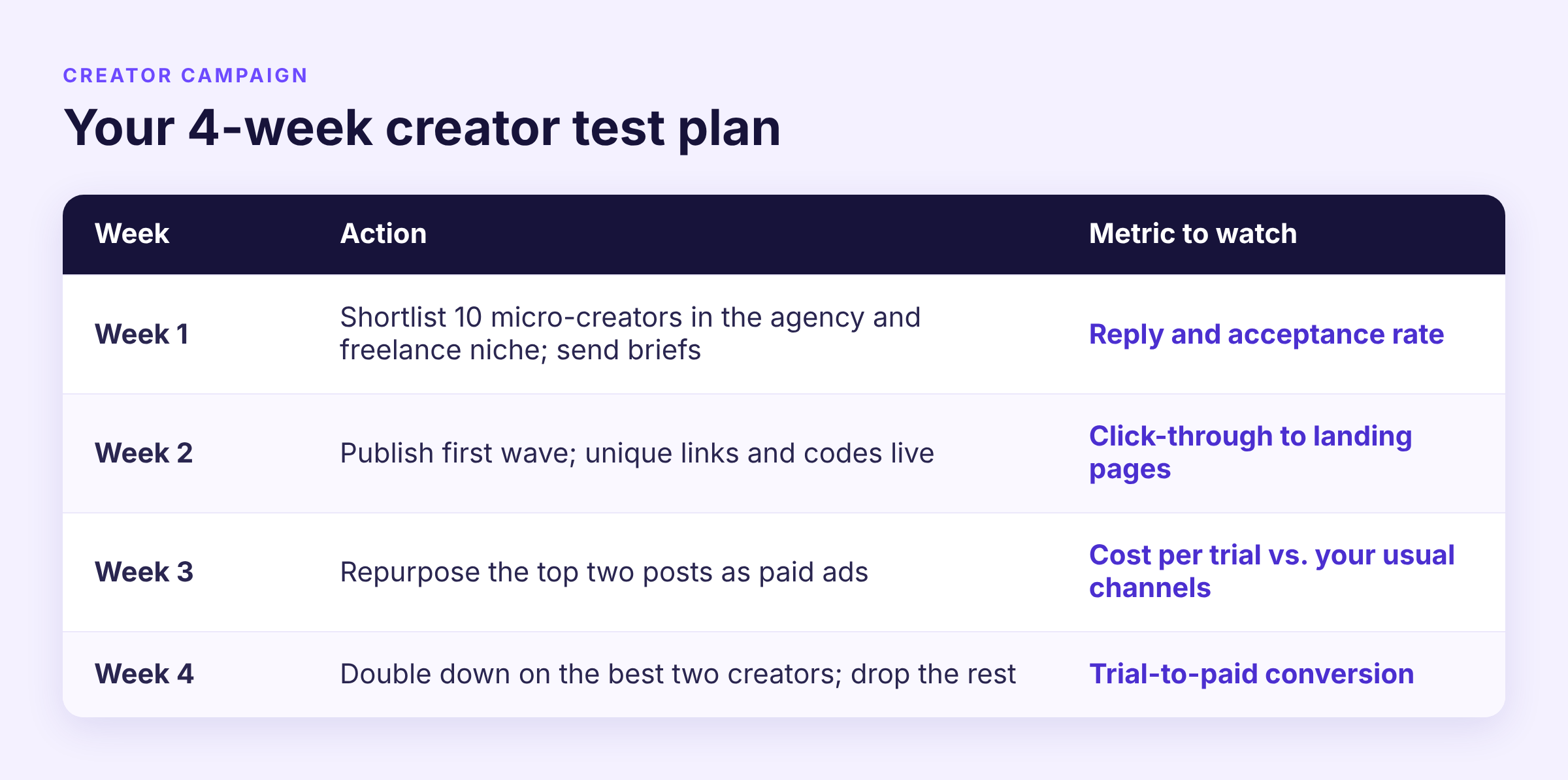
The numbers here are placeholders for your own targets. The structure is the point: test small, measure, then scale the winners.
Mistakes That Quietly Kill Creator Campaigns
- Buying followers, not fit. Roughly 37.2% of Instagram and TikTok followers show signs of being inauthentic in one 100,000-account analysis (SociaVault Labs, via ContentGrip). Always ask for audience analytics.
- One-and-done posts. Always-on beats one-off. Plan at least three touchpoints per creator.
- Sending traffic to the homepage. A generic homepage wastes the warm audience a creator just handed you.
- Over-scripting. If it sounds like an ad, the audience treats it like one.
- Skipping the contract details. Spell out usage rights, exclusivity, disclosure and payment terms in writing.
Your Creator Partnership Checklist
- Define one goal (awareness, trials or demos) and one metric.
- Shortlist 8 to 10 creators using the audience-fit filter.
- Use a hybrid payment structure with a usage license.
- Give each creator a unique link and promo code.
- Require clear disclosure.
- Build the landing page, asset kit and ad variants before launch.
- Review results at day 14 and day 30, then cut and scale.
The Bottom Line
Whether or not you ever work with a name like Pokimane, the lesson from today’s trending moment is the same: audiences follow people they trust. Creator partnerships for SaaS let you earn that trust faster, as long as you choose creators for fit, pay for performance, disclose clearly, and design a landing experience worthy of the attention you are paying for.
Need the Design Side Handled?
At Draftss, our unlimited design subscription covers the assets creator campaigns depend on: landing page designs, co-branded kits, social templates and ad creatives, turned around quickly so you can launch while the moment is hot. See how an unlimited social media design plan works, or compare options in our roundup of the top unlimited graphic design services and unlimited marketing services.
Ready to launch your first creator campaign? Start a Draftss subscription and get your creator-ready design kit built in days, not weeks.